
2A, 2B, and 2C Hair: The Complete Guide to Wavy Hair
Nov 03, 2026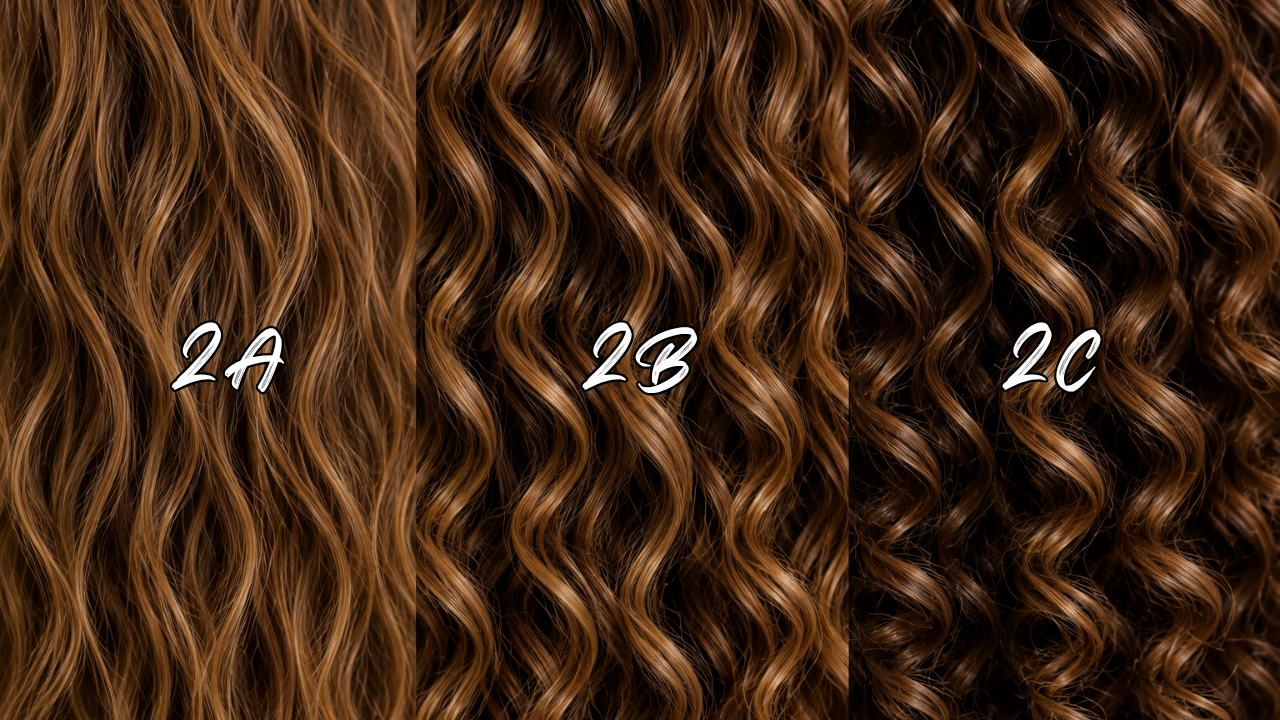
If you have wavy hair, you’ve probably seen the terms 2A, 2B, and 2C hair tossed around online. These labels are commonly used to describe different Type 2 hair patterns, from loose, barely-there waves to stronger S-shaped bends that can look almost curly. They can be helpful for describing what your hair looks like, especially since many people have more than one wave pattern on their head.
But here’s the important part: your curl pattern describes shape, not what your hair needs. Knowing your wavy hair type can give you vocabulary, not a complete hair-care routine.
First, A Note About Curl Patterns
Curl patterns can be useful for describing what your hair looks like, but they are not a roadmap for what your hair needs.
At Curly Canvas, we do not recommend choosing products, routines, techniques, or treatments based only on whether your hair is labeled 2A, 2B, or 2C. Two people can have nearly identical-looking waves and still need completely different care.
That’s because curl pattern is only one small piece of the picture. Things like porosity, density, strand thickness, damage, scalp needs, lifestyle, and environment all affect how your hair behaves and what works best for it.
So yes, it can be helpful to know whether your hair looks more like 2A, 2B, or 2C, especially when you’re trying to describe your texture or make sense of the language you see online.
Just don’t let a curl-type label become the boss of your whole routine.
Curl pattern describes shape. It does not tell you what your hair needs.
What Is Type 2 Hair?
Type 2 hair is the commonly used category for wavy hair. Instead of lying completely straight or forming consistent curls, Type 2 hair usually develops visible S-shaped bends through some or all of the length.
That spectrum can be pretty wide. Some waves are soft and loose enough that the hair may look almost straight in certain areas, while others are much stronger and can sit right on the edge of looking curly. That’s where the familiar 2A, 2B, and 2C labels come in.
But curl pattern is only describing the visible shape of the hair. It does not tell you everything about the hair itself.
Two people can both have Type 2 hair and still have very different texture, density, porosity, strand thickness, damage levels, and scalp needs. Those characteristics are separate from whether the hair looks wavy.
So when we talk about Type 2 hair, we are really talking about what the pattern looks like, not making assumptions about how the hair should be treated.
The Difference Between 2A, 2B, and 2C Hair
The difference between 2A, 2B, and 2C hair mostly comes down to how strong and defined the visible wave pattern is. Think of them as points along a wavy-hair spectrum rather than three perfectly separate boxes.
At one end, 2A hair tends to have very loose, soft bends. In the middle, 2B hair usually forms more noticeable S-shaped waves. At the stronger end of the spectrum, 2C hair often has deeper waves and may even form a few loose spirals.
Real hair does not always fit neatly into one label, though. You may have 2A waves around your face, 2B through the back, and a random 2C section doing its own thing.
The categories are useful for describing pattern. They are not rules your hair has to follow.
What Does 2A Hair Look Like?
2A hair usually has the loosest wave pattern within the Type 2 category. The hair often looks fairly straight near the roots, with soft, stretched-out S-shaped bends becoming more noticeable through the mid-lengths and ends.
Because the pattern is subtle, type 2A hair can sometimes look almost straight, especially when it is brushed out, weighed down, or left without much styling support. On other days, the waves may show up more clearly. That variation is normal.
2A wavy hair also tends to have less dramatic definition than 2B or 2C hair, so the visible wave pattern may relax or fall out more easily over the course of the day.
The main thing to look for is not perfect symmetry or identical waves everywhere. Instead, look for a recurring soft bend through the hair rather than consistent spirals or ringlets.
And remember, identifying 2A hair tells you what the pattern looks like. It still does not tell you everything about the hair’s density, porosity, strand thickness, scalp needs, or how it should be cared for.
What Does 2B Hair Look Like?
2B hair usually has a more noticeable wave pattern than 2A hair. Instead of soft bends that show up mostly through the ends, type 2B hair tends to form clearer S-shaped waves through more of the length.
The pattern is often easier to spot at a glance, with more visible definition and movement throughout the hair. Some sections may look softer and looser, while others form stronger bends, especially around the sides, underneath layers, or anywhere the hair naturally clumps together.
2B wavy hair can also be more prone to visible frizz, but frizz itself does not determine whether hair is 2B. The most useful clue is the repeating S-shaped pattern.
And just like with 2A hair, you do not need every strand to match perfectly. Mixed patterns are normal, so someone with mostly 2B hair may also have a few 2A or 2C sections.
The label is simply a way to describe the visible wave shape. It does not tell you what products, techniques, or routine your hair needs.
What Does 2C Hair Look Like?
2C hair has the strongest visible wave pattern within the Type 2 category. The waves are usually deeper, more defined, and often begin closer to the roots than they do with 2A or 2B hair.
With type 2C hair, the overall pattern can look very full and textured because the S-shaped waves are more pronounced throughout the length. Some sections may even form loose spirals or curl-shaped pieces, which is why 2C wavy hair is sometimes confused with 3A curls.
The difference is that 2C hair is still primarily made up of strong waves, while 3A hair tends to form more consistent spiral or ringlet shapes.
You may also notice more visual volume simply because the pattern is stronger and takes up more space. And, as with every curl type, one head of hair can include several different patterns at once.
So if most of your hair forms strong S-shaped waves with a few loose curls mixed in, 2C may be the closest description. It is still just that: a description of shape, not a set of instructions for how your hair should be treated.
2A vs. 2B vs. 2C Hair at a Glance
The easiest way to compare 2A, 2B, and 2C hair is to look at the strength of the wave, how much of the hair shows a visible pattern, and where that pattern tends to begin.
As you move from 2A to 2C, the waves generally become more pronounced. 2A hair tends to have softer, looser bends, while 2B hair develops clearer S-shaped waves. 2C hair usually has the strongest wave pattern and may even include a few loose spiral-shaped pieces.
Keep in mind that real hair does not always fit neatly into a chart. Your head may include characteristics of two or even all three Type 2 patterns.
How Do I Know If My Hair Is 2A, 2B, or 2C?
If you’re trying to figure out whether your hair looks more like 2A, 2B, or 2C, the best place to start is by looking at your natural pattern rather than how your hair behaves after a full styling routine. Remember, this is just a way to describe the shape of your waves, not a shortcut for choosing products.
Look at Clean Hair With Minimal Product
Heavy creams, gels, brushing, stretching, or heat can all change how your waves look. If possible, look at your hair when it is clean, dry, and wearing very little product so you can see the pattern more clearly.
Look at the Shape, Not Just the Frizz
Frizz does not determine curl type. A very frizzy head of hair is not automatically 2C, and smooth hair is not automatically 2A. Focus on the repeating bends and waves instead.
Look at Where the Wave Begins
Loose waves that become more visible lower down often resemble 2A hair. More obvious S-shaped waves through the mid-lengths often resemble 2B hair. Stronger waves that begin closer to the root often look more like 2C hair.
Look at Several Sections of Your Head
Do not judge your entire head by one section. Mixed patterns are common. You might have 2A and 2B waves together, 2B and 2C, or even mostly 2C hair with a few 3A curl-shaped pieces mixed in.
The goal is not to force your hair into one perfect box. It is simply to find the description that fits most of what you see.

Can You Have More Than One Wavy Hair Type?
Yes. In fact, having more than one visible wave or curl pattern on the same head is completely normal.
You might have looser 2A waves around one area, stronger 2B waves through another, and a few 2C or even 3A pieces hiding underneath. Hair does not grow in perfectly coordinated little rows, so every section does not have to behave the same way.
The pattern you see can also change depending on hair length, damage, hormones, weather, humidity, styling, and even where a section grows on your head. A heavier section may look looser, while shorter pieces around the face may spring up more.
This is another reason curl typing works best as a general description rather than a strict classification system.
You do not need to inspect every strand and assign it a letter.
Your hair does not have to pass a standardized exam and receive an official 2B certificate.
If several patterns show up on your head, that does not mean you are identifying your hair incorrectly. It simply means your hair has more than one pattern.

Is 2C Hair Wavy or Curly?
2C hair is generally categorized as wavy hair in the common curl-typing system, but it sits right on the edge of Type 3 curly hair. That is why the line between 2C wavy hair and 3A curls can feel a little blurry.
Most 2C hair is still dominated by strong S-shaped waves, but some sections may form loose spirals or ringlet-like pieces. Those curlier sections do not automatically make the entire head 3A.
So, is 2C hair curly? Usually, it is described as wavy. But in real life, the pattern can overlap visually with looser curls, especially when different sections of the head behave differently.
The best way to think about 2C vs. 3A is to look at the overall pattern. If most of the hair forms strong waves with a few spirals mixed in, it is likely closer to 2C. If the hair forms consistent ringlets or spirals through much of the head, it may look more like 3A.
These labels are descriptive tools, not laws your hair has to obey.
2C Hair vs. 3A Hair: What Is the Difference?
The difference between 2C hair and 3A hair usually comes down to the overall shape of the pattern. 2C hair is still mostly made up of strong S-shaped waves, while 3A hair tends to form more consistent spirals, loops, or loose ringlets.
That overlap is exactly why the two are so often confused. Some 2C hair includes a few curlier pieces, especially underneath or around the face. And some 3A hair may have looser sections that look almost wavy. Mixed patterns are normal.
The key is to look at the majority of the hair rather than one particularly dramatic section. One ringlet does not automatically make an entire head of hair 3A, just like one loose section does not erase a curl pattern.
If most of the hair forms pronounced waves with only a few spiral-shaped pieces, it is likely closer to 2C. If the hair forms loose but repeated ringlets across much of the head, it is likely closer to 3A.
As always, these labels are most useful as visual descriptions. They are not a diagnosis, and they are not a rulebook for how your hair should be treated.
Does Curl Type Determine Your Hair Routine?
No! And this is one of the biggest misconceptions about wavy hair.
Knowing whether you have 2A, 2B, or 2C hair can help you describe your wave pattern, but it doesn't tell you which shampoo, conditioner, styling products, or techniques will work best for your hair.
At Curly Canvas, we believe your hair-care routine should be built around what your hair actually needs, not just the shape it makes.
Several other characteristics play an important role:
-
Hair porosity: How your hair absorbs and retains moisture.
-
Hair density: How many strands of hair grow on your scalp.
-
Strand thickness: Whether your individual hair strands are fine, medium, or coarse.
-
Scalp health: Whether your scalp tends to be oily, dry, sensitive, or experiences buildup.
-
Hair condition: How damage, chemical treatments, and everyday wear affect your hair.
Two people with beautiful 2B waves might need completely different routines. One may have fine, low-density hair, while the other has coarse strands and high-density hair.
Same wave pattern. Different needs.
Your curl type tells you what your hair looks like. Understanding your hair's characteristics helps you figure out how to care for it.
Final Thoughts: Understanding Your Wavy Hair
Whether your waves are soft and subtle like 2A, more defined like 2B, or strong and nearly curly like 2C, there's no perfect category your hair needs to fit into.
Curl typing can be a fun and useful way to understand your natural pattern, but it's only one small part of getting to know your hair.
At Curly Canvas, we're more interested in helping you understand your hair than handing you a routine based on a letter and number.
And if you've discovered that your hair forms more consistent spirals or tighter coils, you might enjoy exploring our guides to Type 3 curly hair and Type 4 coily hair.
Because beautiful hair doesn't come from fitting into a category. It comes from understanding the hair you actually have.
Stay in the loop. Get Curl Letters.
The good kind of inbox surprise.
We hate SPAM. We will never sell your information, for any reason.
